Finally, We’re Trusting GPs With ADHD. About Time.
Dr Michael Carr-Gregg AO, February 3, 2026
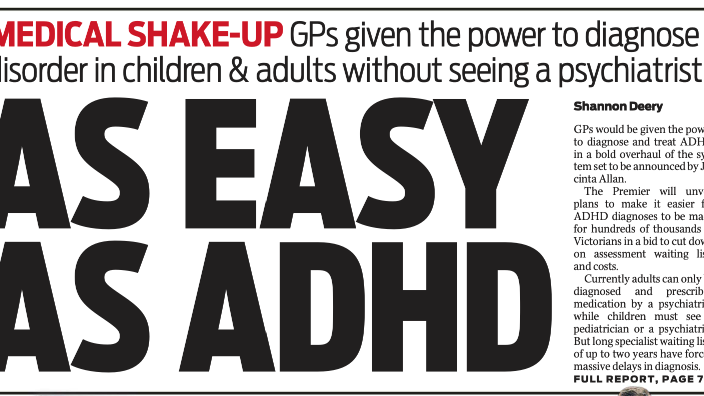
The Victorian government has announced that GPs will now be allowed to diagnose and treat ADHD in adults and children as part of reforms to reduce long waits and high costs for specialist assessment. The announcement includes an initial investment to train around 150 GPs by September 2026 so they can expand their scope to safely diagnose, treat and prescribe for ADHD. Putting aside the fact that four other states/territories (Queensland, NSW, WA, and SA) had either already implemented or announced reforms - this is a great move.
Cue the pearl-clutching. Cue the think pieces about “over-diagnosis.” Cue the sudden concern for patient safety from people who have never tried to book a psychiatrist or a paediatrician in this state. But for anyone who actually lives with ADHD — or loves someone who does—this reform isn’t radical. It’s long overdue.
For years, ADHD has been treated like a niche, specialist-only condition, as if recognising a lifelong neurodevelopmental disorder requires a crystal ball and a three-year waitlist. Adults have been bounced between referrals, told their symptoms are “stress,” “anxiety,” or a personality flaw, and left untreated while their lives quietly unravel. Parents have watched their kids struggle at school while paperwork crawls through a system designed for scarcity, not care.
All the while, the evidence has been clear: ADHD is common, well-researched, and treatable. And GPs—who already diagnose and manage depression, anxiety, diabetes, asthma, and countless other chronic conditions—are more than capable of doing this work. The idea that only psychiatrists can safely diagnose ADHD has never really been about safety. It’s been about gatekeeping.
In Victoria, opposition or strong caution about expanding GPs’ role in diagnosing and treating ADHD (especially prescribing stimulants) has mainly come from psychiatrists (via their professional bodies. Let’s be honest about what the old system produced. It didn’t protect patients; it delayed care. It didn’t ensure rigour; it ensured privilege. If you had money, time, and the ability to navigate a labyrinth of referrals, you got help. If you didn’t, you were told to cope better, try harder, or wait another year. That’s not clinical excellence. That’s rationing dressed up as caution.
GPs are already the backbone of our health system, especially for children and teenagers. They know their patients. They see the full picture—mental health, physical health, family context, history over time. They are often the first to suspect ADHD, and until now, they’ve been forced to stop just short of actually helping. This reform closes that absurd gap.
It also reflects a reality policymakers have been slow to accept: ADHD doesn’t magically appear in childhood and vanish at 18. Adults have ADHD. Women have ADHD. People who weren’t disruptive at school, who internalised their struggles, who masked and compensated and burned out quietly—have ADHD. These are the very people most likely to fall through a specialist-only system.
Critics warn this change will lead to “over-diagnosis.” But what they really mean is more diagnosis. And when a condition has been systematically under-recognised for decades, that’s not a problem—it’s a correction. We don’t accuse GPs of “over-diagnosing” asthma because more people get inhalers. We don’t panic about “too much depression” when antidepressants become more accessible. We recognise unmet need. ADHD should be no different.
Of course, this doesn’t mean every GP suddenly becomes a lone cowboy/cowgirl handing out scripts. Training, guidelines, and clear pathways matter. Complex cases will still need specialists. Safeguards should exist. None of that is incompatible with trusting GPs to do what they already do every day: assess, diagnose, monitor, and refer when needed. What is incompatible is a system that treats ADHD like a rare indulgence instead of a mainstream health issue.
This reform is about more than efficiency. It’s about dignity. It’s about believing patients when they describe their own lives. It’s about recognising that long waitlists are not a virtue, and suffering is not a prerequisite for care. Victoria hasn’t lowered the bar. It’s removed an unnecessary wall. And for thousands of people who’ve spent years stuck on the wrong side of it, that’s not just policy. It’s relief. Finally.
Celebrate the End of Exams – Not Just the ATAR
Every year, thousands of exhausted Year 12s stumble out of their final exam rooms, eyes glazed, brains fried and hearts pounding — only to be told: “Don’t celebrate yet. Wait for the results.”

Every year, thousands of exhausted Year 12s stumble out of their final exam rooms, eyes glazed, brains fried and hearts pounding — only to be told: “Don’t celebrate yet. Wait for the results.”
What absolute nonsense. We should be celebrating now — not because of a number that arrives in December, but because they’ve just completed one of the most demanding endurance events of their young lives. The exams are done. The pressure cooker is over. That deserves recognition, not another month of purgatory.
Let’s be clear. Year 12 exams have become absurdly over-hyped — inflated into a supposed measure of intelligence, worth and future success. In reality, they test how well you can recall and regurgitate information under artificial, time-pressured conditions. They measure memory, technique and exam temperament — not creativity, emotional intelligence, or resilience.
And let’s not forget the glaring inequities: access to tutors, calm home environments, supportive schools and mental health stability all play massive roles. The ATAR isn’t a measure of capability — it’s a snapshot of performance in a narrow window of time.
The truth? Year 12 exams measure how well you can play the game. They reward those who can decode marking rubrics, spot past-paper patterns, and manage their nerves. Those are useful skills, sure — but they’re hardly the full story of human potential.
Some of the brightest, most original thinkers I’ve met weren’t top-scoring students. Many didn’t peak at 17 or 18. They bloomed later — once they found a path that matched their strengths, passions and temperament.
In 2025, there are dozens of ways to get where you want to go.
Bridging programs, TAFE pathways, early-entry schemes, apprenticeships, micro-credentials — the traditional ATAR-to-uni pipeline is just one route among many. Employers are increasingly valuing character, creativity, collaboration and digital literacy over a number on a piece of paper.
The world has changed. Our young people know it. It’s time parents and educators caught up. So, if you’ve got a Year 12 student in your life, celebrate them now. Book the dinner, bake the cake, give them a hug and tell them you’re proud — not because of what they scored, but because they showed up, persevered, and survived one of the most stressful rites of passage in Australia.
The results will come and go. But the grit, growth and self-knowledge they gained this year? That’s the real achievement.
Definitely Don't Ditch Dinner
It’s a statistic that might make you pause mid-bite. New findings from the University of Sydney show more than 40% of young Aussies are lonely. It’s a growing crisis in Australia, but modern life is eroding our ability to connect. And, while loneliness has many causes, experts are pointing to a quiet culprit hiding in plain sight – the decline of family dinner time.
Hello Fresh Partnership!
It’s a statistic that might make you pause mid-bite. New findings from the University of Sydney show more than 40% of young Aussies are lonely. It’s a growing crisis in Australia, but modern life is eroding our ability to connect. And, while loneliness has many causes, experts are pointing to a quiet culprit hiding in plain sight – the decline of family dinner time.
Dinner time has long done more than just fuel up the family – it sparks storytelling, settles arguments, and strengthens family bonds each night.. But according to HelloFresh’s new State of Dinner time report, that ritual is under threat. Only a third of Aussie families now sit down together for dinner each night, while 5% don’t have dinner together at all.
“Even in households with strict rules, phones and devices sneak onto the table,” says Dr. Michael Carr-Gregg, a leading Australian psychologist who works with HelloFresh to explore the impacts of modern life on family connections. “It’s not just about food. Dinner time is an opportunity for families to talk, to listen, and to truly engage with one another. Losing that time chips away at our emotional health.”
The report shows that modern life has turned dinner into a functional task rather than a family ritual. Busy work schedules and late nights at the office are the biggest barriers to shared meals (51%), closely followed by after-school commitments (49%), screen distractions (33%), and sheer exhaustion (29%).Meanwhile, over half of parents (51%) spend more time planning and prepping dinner than they do actually spending time with the family.
Screens are the top disruptor, with 34% of parents admitting to watching TV over dinner most nights. Even in households where 42% of parents ban devices at the table,22% of family members sneak them in anyway. Other interruptions range from arguments over disliked meals (28%) and sports on TV (27%) to sudden new food aversions from the kids (27%).
Despite the challenges, parents understand the true value of dinner together.
The HelloFresh report reveals:
79% of Aussie parents see dinner time as the most important family touchpoint of the day
89% say it’s a chance to reconnect after a busy day
57% agree that the best, “real” conversations happen at the dinner table
45% say without dinner, they’d struggle to find other time to connect
66% worry that a lack of connection at dinner affects their children’s routine, rhythm, and structure

Nostalgia also plays a role. Six out of ten parents agree dinner felt more meaningful when they were kids. Today, 59% of families describe dinner as a rushed, “tickbox” activity, and 54% feel it’s become more about convenience than connection. Repeating the same meals week after week doesn’t help – 35% of parents say they have only up to five dinners in rotation, while 43% admit that the daily “what’s for dinner?” struggle has stripped the joy from mealtime.
Clearly, something’s cooking – and it’s not just dinner. Aussie families say more fun and variety are key. 60% want to bring new and inspiring meals into the irrotation, while 26% suggest inviting friends and family over mid-week, and another 26% think using the “good plates” can make the meal feel special. HelloFresh’s meal solutions aim to take the stress out of planning and prep, helping families reclaim that lost joy – and the deeper connections that come with it.
“Dinner time is where empathy, communication, and belonging are built,” says Dr Carr-Gregg. By keeping families at the table, even a few nights a week, we nourish not just our bodies but our relationships. And in a world where loneliness is on the rise, that simple act can make all the difference.”
Loneliness may feel like a complex societal problem, but sometimes the solution is simple– found around the dining table, plate by plate, story by story. After all, a family that eats together doesn’t just feed the body – it feeds the soul
Tune in to The Today Show on Sunday morning at 8:40am (ish) to see Michael’s latest tips.